Attention: Here be dragons
This is the latest
(unstable) version of this documentation, which may document features
not available in or compatible with released stable versions of Godot.
Checking the stable version of the documentation...
入門
工作流程總覽
作為 GDExtension,godot-cpp 的使用會比 GDScript 與 C# 複雜。若你決定使用它,你的工作流程大致如下:
建立新的 godot-cpp 專案(可使用 範本,或依下文從零開始)。
在本機使用你 偏好的 IDE 進行開發。
使用最早支援的 Godot 版本建置並測試你的程式碼。
Create builds for all platforms you want to support (e.g. using GitHub Actions).
Optional: Publish on the Godot Asset Store.
範例專案
第一次使用 godot-cpp 時,建議先依本指南了解 godot-cpp 涉及的技術。完成後,你可以改用 godot-cpp 範本,它涵蓋更多功能,例如 GitHub 動作工作流程與實用的 SConstruct 樣板程式碼。不過該範本本身沒有提供詳細說明,因此我們建議先讀完本指南。
設定專案
你需要先準備以下幾項:
Godot 4 可執行檔。
C++ 編譯器。
SCons 作為建置工具。
一份 godot-cpp 儲存庫 的複本。
另請參閱 設定 IDE 與 編譯,因為這些建構工具與從原始碼編譯 Godot 使用的工具相同。
你可以從 GitHub 下載 godot-cpp 倉庫,或用 Git 指令自動抓取。請注意,這個倉庫針對不同的 Godot 版本有不同分支。GDExtension 僅支援 Godot 4 及以上版本,且不同版本之間不相容,所以請務必下載正確的分支。
備註
要使用 GDExtension,你必須使用與目標 Godot 版本相符的 godot-cpp 分支。例如,如果你的目標是 Godot 4.1,請使用 4.1 分支。本教學以 4.x 為例,實際操作時請依你的目標版本替換分支名稱。
master 分支是開發中的分支,會定期與 Godot 的 master 分支同步更新。
警告
以較早的 Godot 版本為目標所建置的 GDExtension 通常可在後續的小版本中運作,反之則不行。例如,目標為 Godot 4.2 的 GDExtension 在 Godot 4.3 應可正常運作,但目標為 Godot 4.3 的 GDExtension 無法在 Godot 4.2 運作。
此規則有一個例外: 以 Godot 4.0 為目標的擴充在 Godot 4.1 及後續版本中將 無法 運作 (請見 將 GDExtension 更新到 4.1)。
如果你有用 Git 進行專案版本管理,建議將它加為 Git 子模組:
mkdir gdextension_cpp_example
cd gdextension_cpp_example
git init
git submodule add -b 4.x https://github.com/godotengine/godot-cpp
cd godot-cpp
git submodule update --init
你也可以直接將它 clone 到專案目錄下:
mkdir gdextension_cpp_example
cd gdextension_cpp_example
git clone -b 4.x https://github.com/godotengine/godot-cpp
備註
如果你選擇直接下載或 clone 倉庫到資料夾,請務必保持資料夾結構與本教學一致,因為後續範例程式碼都假設你的專案有這樣的結構。
如果你是從前面介紹的連結 clone 範例,子模組預設並不會自動初始化,你需要手動執行以下指令:
cd gdextension_cpp_example
git submodule update --init
這會在你的專案資料夾中初始化所需的子模組。
建立簡單外掛
現在來實作一個真正的外掛。我們將先建立一個空的 Godot 專案,並在裡面放入一些檔案。
Open Godot and create a new project. For this example, we will place it in a
folder called project inside our GDExtension's folder structure.
In our project, we'll create a scene containing a Node called "Main" and
we'll save it as main.tscn. We'll come back to that later.
回到 GDExtension 模組的根目錄,再建立一個名為 src 的子資料夾,這之後會用來放我們的原始碼檔案。
You should now have project, godot-cpp, and src
directories in your GDExtension module.
目前的資料夾結構應該長這樣:
gdextension_cpp_example/
|
+--project/                  # game example/demo to test the extension
|
+--godot-cpp/             # C++ bindings
|
+--src/                   # source code of the extension we are building
在 src 資料夾下,先建立我們要用來擴充的 GDExtension 節點的標頭檔,我們把它命名為 gdexample.h:
#pragma once

#include <godot_cpp/classes/sprite2d.hpp>

namespace godot {

class GDExample : public Sprite2D {
    GDCLASS(GDExample, Sprite2D)

private:
    double time_passed;

protected:
    static void _bind_methods();

public:
    GDExample();
    ~GDExample();

    void _process(double delta) override;
};

} // namespace godot
上面程式碼有幾點要注意。我們引入了 sprite2d.hpp,這個檔案包含對 Sprite2D 類的綁定。我們會以這個類別做為擴充的基礎。
我們使用 godot 命名空間,因為 GDExtension 所有內容都定義在此命名空間中。
接下來是類別定義,這裡我們透過容器類別繼承自 Sprite2D。GDCLASS 巨集會幫我們處理一些必要的內部註冊。
接著宣告了一個名為 time_passed 的成員變數。
在接下來的方法區塊中,除了建構子和解構子,還有兩個你可能很熟悉的方法,另外還有一個新方法。
第一個是 _bind_methods,Godot 會呼叫這個靜態方法來註冊可以被呼叫的方法和屬性。第二個是 _process,它的功能就跟你在 GDScript 使用的 _process 一樣。
接下來,實作這些方法並建立 gdexample.cpp 檔案:
#include "gdexample.h"
#include <godot_cpp/core/class_db.hpp>

using namespace godot;

void GDExample::_bind_methods() {
}

GDExample::GDExample() {
    // Initialize any variables here.
    time_passed = 0.0;
}

GDExample::~GDExample() {
    // Add your cleanup here.
}

void GDExample::_process(double delta) {
    time_passed += delta;

    Vector2 new_position = Vector2(10.0 + (10.0 * sin(time_passed * 2.0)), 10.0 + (10.0 * cos(time_passed * 1.5)));

    set_position(new_position);
}
這部分很直接,就是把我們在標頭檔定義的每個方法實作出來。
請注意 _process 方法,它會累計經過的時間,並用正弦、餘弦計算新的精靈位置。
我們還需要另外一個 C++ 檔案,命名為 register_types.cpp。一個 GDExtension 外掛可以有多個類別,每個類別有自己的標頭和原始檔,像前面那樣實作 GDExample。現在我們需要一小段程式碼告訴 Godot 外掛裡有哪些類別。
#include "register_types.h"

#include "gdexample.h"

#include <gdextension_interface.h>
#include <godot_cpp/core/defs.hpp>
#include <godot_cpp/godot.hpp>

using namespace godot;

void initialize_example_module(ModuleInitializationLevel p_level) {
    if (p_level != MODULE_INITIALIZATION_LEVEL_SCENE) {
        return;
    }

    GDREGISTER_CLASS(GDExample);
}

void uninitialize_example_module(ModuleInitializationLevel p_level) {
    if (p_level != MODULE_INITIALIZATION_LEVEL_SCENE) {
        return;
    }
}

extern "C" {
// Initialization.
GDExtensionBool GDE_EXPORT example_library_init(GDExtensionInterfaceGetProcAddress p_get_proc_address, const GDExtensionClassLibraryPtr p_library, GDExtensionInitialization *r_initialization) {
    godot::GDExtensionBinding::InitObject init_obj(p_get_proc_address, p_library, r_initialization);

    init_obj.register_initializer(initialize_example_module);
    init_obj.register_terminator(uninitialize_example_module);
    init_obj.set_minimum_library_initialization_level(MODULE_INITIALIZATION_LEVEL_SCENE);

    return init_obj.init();
}
}
The initialize_example_module and uninitialize_example_module functions get
called respectively when Godot loads our plugin and when it unloads it. All
we're doing here is parse through the functions in our bindings module to
initialize them, but you might have to set up more things depending on your
needs. We call the GDREGISTER_CLASS macro for each of our classes in our library.
備註
You can find information about GDREGISTER_CLASS (and alternatives) at Object 類別.
第三個函式 example_library_init 很重要。我們會先呼叫綁定庫的初始化函式來建立初始化物件,這個物件會註冊 GDExtension 的初始化與終結函式,也能設定初始化階段(如 core、servers、scene、editor、level)。
最後,還需要為 register_types.cpp 建立標頭檔 register_types.h。
#pragma once

#include <godot_cpp/core/class_db.hpp>

using namespace godot;

void initialize_example_module(ModuleInitializationLevel p_level);
void uninitialize_example_module(ModuleInitializationLevel p_level);
編譯外掛
To compile the project we need to define how SCons using should compile it
using an SConstruct file which references the one in godot-cpp.
Writing it from scratch is outside the scope of this tutorial, but you can download
the SConstruct file we prepared.
We'll cover a more customizable, detailed example on how to use these
build files in a subsequent tutorial.
備註
這個 SConstruct 檔案是針對最新的 godot-cpp master 分支撰寫的,如要與舊版搭配使用,可能需做些微調整或參考 Godot 4.x 文件的 SConstruct 範例。
Once you've downloaded the SConstruct file, place it in your GDExtension folder
structure alongside godot-cpp, src, and project, then run:
scons platform=<platform>
You can omit the platform option if you are compiling for the platform you
are currently using. The list of available platform options depends on which
platform dependencies are set up (use platform=list to see all available platforms).
See 建置系統介紹 for details.
You should now be able to find the compiled library in project/bin/.
備註
Here, we've compiled both godot-cpp and our gdexample library as debug
builds, which is the default. For optimized builds, you should compile
them using the target=template_release option.
使用 GDExtension 模組
Before we jump back into Godot, we need to create one more file in
project/bin/.
這個檔案讓 Godot 知道要針對各平台載入哪些動態函式庫,以及模組的進入點。名稱為 gdexample.gdextension。
[configuration]

entry_symbol = "example_library_init"
compatibility_minimum = "4.1"
reloadable = true

[libraries]

macos.debug = "./libgdexample.macos.template_debug.dylib"
macos.release = "./libgdexample.macos.template_release.dylib"
windows.debug.x86_32 = "./gdexample.windows.template_debug.x86_32.dll"
windows.release.x86_32 = "./gdexample.windows.template_release.x86_32.dll"
windows.debug.x86_64 = "./gdexample.windows.template_debug.x86_64.dll"
windows.release.x86_64 = "./gdexample.windows.template_release.x86_64.dll"
linux.debug.x86_64 = "./libgdexample.linux.template_debug.x86_64.so"
linux.release.x86_64 = "./libgdexample.linux.template_release.x86_64.so"
linux.debug.arm64 = "./libgdexample.linux.template_debug.arm64.so"
linux.release.arm64 = "./libgdexample.linux.template_release.arm64.so"
linux.debug.rv64 = "./libgdexample.linux.template_debug.rv64.so"
linux.release.rv64 = "./libgdexample.linux.template_release.rv64.so"
此檔案包含 configuration 區段,用於控制模組的進入點函式。你也應以 compatibility_minimum 設定最低相容的 Godot 版本,避免舊版 Godot 嘗試載入你的擴充。reloadable 旗標可讓你在每次重新編譯後,由編輯器自動重新載入擴充,而不必重新啟動編輯器。這僅在以除錯模式(預設)編譯擴充時有效。
libraries 區段很重要:它會告訴 Godot 每個支援平台下動態函式庫的路徑。這也確保你匯出專案時只會包含目標平台需要的函式庫,不會把不相容的函式庫一併打包。
You can learn more about .gdextension files at .gdextension 檔案.
以下是正確檔案結構的總覽:
gdextension_cpp_example/
|
+--project/                  # game example/demo to test the extension
|   |
|   +--main.tscn
|   |
|   +--bin/
|       |
|       +--gdexample.gdextension
|
+--godot-cpp/             # C++ bindings
|
+--src/                   # source code of the extension we are building
|   |
|   +--register_types.cpp
|   +--register_types.h
|   +--gdexample.cpp
|   +--gdexample.h
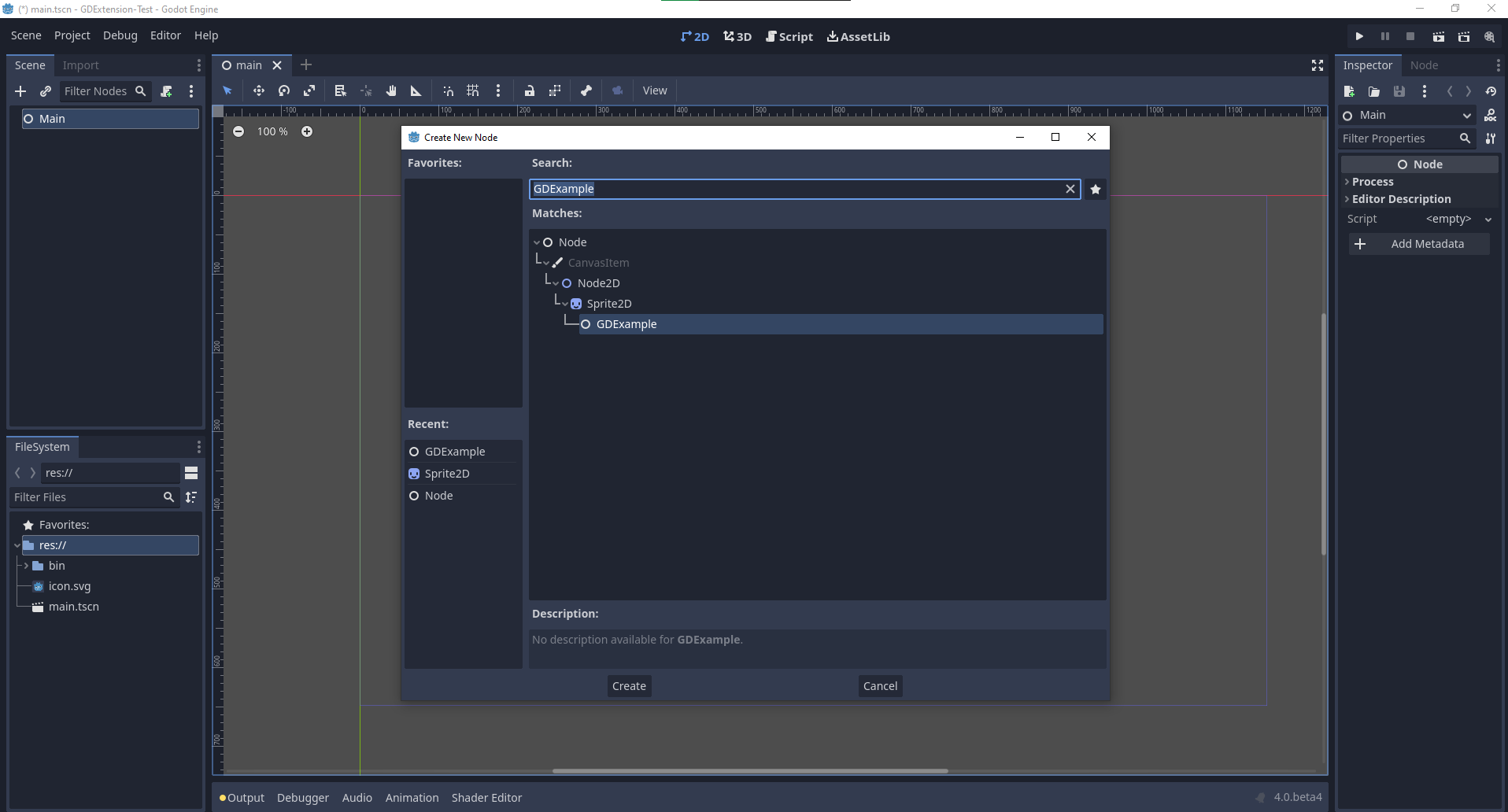
現在可以回到 Godot。請打開一開始建立的主場景,並新增一個 GDExample 節點到場景中:
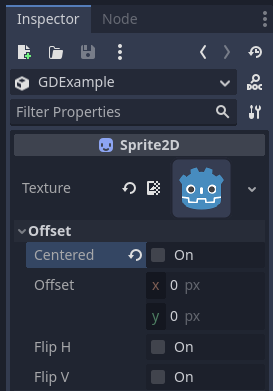
我們將 Godot 標誌指定為這個節點的紋理,並將 centered 屬性關閉:
現在一切就緒,可以執行專案了:
新增屬性
GDScript 可以用 export 關鍵字讓腳本有可編輯屬性。在 GDExtension 則需用 getter 和 setter 方法註冊屬性,或直接實作物件的 _get_property_list、_get、_set 方法(但這屬進階內容,不在本教學範圍)。
現在我們來新增一個屬性,讓我們可以調整波動的振幅。
在 gdexample.h 檔案中,新增一個成員變數及 getter/setter 方法:
...
private:
    double time_passed;
    double amplitude;

public:
    void set_amplitude(const double p_amplitude);
    double get_amplitude() const;
...
在 gdexample.cpp 中也需做一些變動,以下只列出有異動的方法,未提及的行請勿移除:
void GDExample::_bind_methods() {
    ClassDB::bind_method(D_METHOD("get_amplitude"), &GDExample::get_amplitude);
    ClassDB::bind_method(D_METHOD("set_amplitude", "p_amplitude"), &GDExample::set_amplitude);

    ADD_PROPERTY(PropertyInfo(Variant::FLOAT, "amplitude"), "set_amplitude", "get_amplitude");
}

GDExample::GDExample() {
    // Initialize any variables here.
    time_passed = 0.0;
    amplitude = 10.0;
}

void GDExample::_process(double delta) {
    time_passed += delta;

    Vector2 new_position = Vector2(
        amplitude + (amplitude * sin(time_passed * 2.0)),
        amplitude + (amplitude * cos(time_passed * 1.5))
    );

    set_position(new_position);
}

void GDExample::set_amplitude(const double p_amplitude) {
    amplitude = p_amplitude;
}

double GDExample::get_amplitude() const {
    return amplitude;
}
將這些變動編譯完成後,就會看到介面多了一個屬性。你可以隨時調整它,執行專案時 Godot 圖示就會隨之變動軌跡幅度。
我們再來對動畫速度做同樣的處理,一樣用 getter 與 setter。在 gdexample.h 標頭檔只需再加幾行:
...
    double amplitude;
    double speed;
...
    void _process(double delta) override;
    void set_speed(const double p_speed);
    double get_speed() const;
...
gdexample.cpp 檔案還要再做幾個小改動,以下只列出異動的部份,其餘請保留原本內容:
void GDExample::_bind_methods() {
    ...
    ClassDB::bind_method(D_METHOD("get_speed"), &GDExample::get_speed);
    ClassDB::bind_method(D_METHOD("set_speed", "p_speed"), &GDExample::set_speed);

    ADD_PROPERTY(PropertyInfo(Variant::FLOAT, "speed", PROPERTY_HINT_RANGE, "0,20,0.01"), "set_speed", "get_speed");
}

GDExample::GDExample() {
    time_passed = 0.0;
    amplitude = 10.0;
    speed = 1.0;
}

void GDExample::_process(double delta) {
    time_passed += speed * delta;

    Vector2 new_position = Vector2(
        amplitude + (amplitude * sin(time_passed * 2.0)),
        amplitude + (amplitude * cos(time_passed * 1.5))
    );

    set_position(new_position);
}

...

void GDExample::set_speed(const double p_speed) {
    speed = p_speed;
}

double GDExample::get_speed() const {
    return speed;
}
這樣編譯後你會看到介面多一個 speed 屬性。調整它就能改變動畫快慢。此外,我們還加上了屬性範圍,前兩個參數為最小與最大值,第三個為步進值。
備註
For simplicity, we've only used the hint_range of the property method. There are a lot more options to choose from. These can be used to further configure how properties are displayed and set on the Godot side. You can find more information on property hints here @GlobalScope.
訊號
最後,GDExtension 也完整支援訊號。如果想讓你的擴充對其他物件發出的訊號有反應,須先對該物件呼叫 connect。我們的 Godot 圖示搖擺例子不太適合這種情境,如果要示範需要更完整的範例。
語法如下:
some_other_node->connect("the_signal", Callable(this, "my_method"));
要將某個節點的 the_signal 訊號連結到我們的 my_method 方法,需在 connect 方法中指定訊號名稱與一個 Callable。Callable 持有待呼叫方法的物件資訊。本例中,它把目前物件實例 this 與 my_method 方法綁定,之後 connect 會將這個 Callable 加入 the_signal 的觀察者。每當 the_signal 發射時,Godot 就知道要呼叫對應物件的方法。
請注意,只有在你事先於 _bind_methods 註冊過 my_method,Godot 才會知道這個方法的存在,才能將訊號連結過來。
如需更多 Callable 相關資訊,請參考類別文件:Callable。
讓你的物件發出訊號也是很常見的需求。這裡我們用搖擺的 Godot 圖示作為例子,每過一秒就發出一個訊號並傳送新的座標。
在 gdexample.h 標頭檔加上新的成員變數 time_emit:
...
    double time_passed;
    double time_emit;
    double amplitude;
...
這次 gdexample.cpp 的變更較多。首先,要在 _init 方法或建構子裡設定 time_emit = 0.0 。剩下兩項修改我們分開說明。
在 _bind_methods 方法中要註冊我們的訊號,範例如下:
void GDExample::_bind_methods() {
    ...
    ADD_PROPERTY(PropertyInfo(Variant::FLOAT, "speed", PROPERTY_HINT_RANGE, "0,20,0.01"), "set_speed", "get_speed");

    ADD_SIGNAL(MethodInfo("position_changed", PropertyInfo(Variant::OBJECT, "node"), PropertyInfo(Variant::VECTOR2, "new_pos")));
}
ADD_SIGNAL 巨集的參數是 MethodInfo。第一個參數為訊號名稱,後續每個參數都是 PropertyInfo,描述訊號會帶入的資料型別與名稱。
這裡我們新增一個名為 "position_changed" 的訊號,有兩個參數:一個是 Object 型別叫做 "node",另一個是 Vector2 型別叫做 "new_pos"。
接下來修改 _process 方法:
void GDExample::_process(double delta) {
    time_passed += speed * delta;

    Vector2 new_position = Vector2(
        amplitude + (amplitude * sin(time_passed * 2.0)),
        amplitude + (amplitude * cos(time_passed * 1.5))
    );

    set_position(new_position);

    time_emit += delta;
    if (time_emit > 1.0) {
        emit_signal("position_changed", this, new_position);

        time_emit = 0.0;
    }
}
每經過一秒,就發送訊號並重設計時器。我們可以直接把參數丟給 emit_signal。
編譯好 GDExtension 後,回到 Godot 選取精靈節點,在 節點 面板就會看到剛剛新增的訊號,可以按 連接 或直接點兩下連結。主節點加上一個腳本後,訊號可以這樣處理:
extends Node

func _on_Sprite2D_position_changed(node, new_pos):
    print("The position of " + node.get_class() + " is now " + str(new_pos))
每過一秒,我們就會將座標輸出到主控台。
下一步
希望以上範例能讓你掌握基礎。你可以在此基礎上以 C++ 撰寫完整的腳本來控制 Godot 的節點!
與其以以上的範例設定為基礎,我們建議你現在改為複製 godot-cpp 範本,並以它作為專案的起點。該範本涵蓋更多功能,例如 GitHub 建置動作與額外實用的 SConstruct 樣板。